Third-Party Extensions Are Your Biggest Unaudited Attack Surface — Here Is What to Do About It
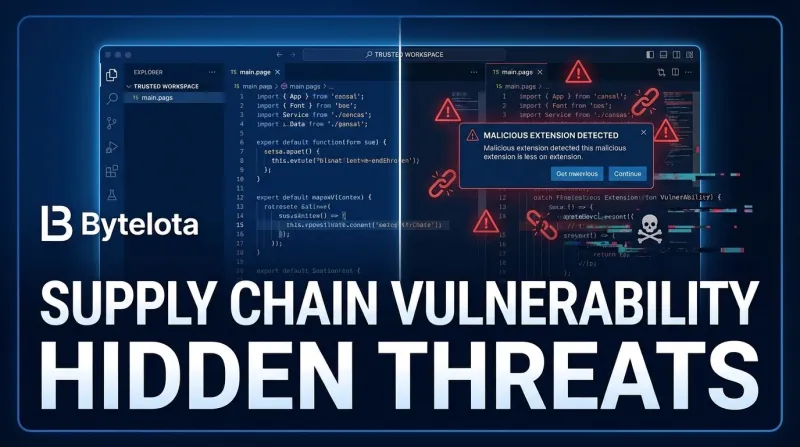
Photo: developer laptop security code vulnerability supply chain, via byteiota.com
There is a particular kind of risk that thrives on convenience. A developer encounters a friction point — a missing feature in their IDE, an absent formatter, a gap in their linting workflow — and within minutes, a third-party extension resolves it. The problem disappears. The extension stays. And nobody asks what came with it.
This pattern, replicated across hundreds of engineers on dozens of teams, has quietly become one of the most consequential security blind spots in modern software development. Supply chain attacks are no longer theoretical. They are documented, recurring, and increasingly sophisticated. Yet the extension vetting process at most organizations remains informal at best and nonexistent at worst.
The Threat Is Already Inside the Toolchain
The software supply chain does not begin at your application's dependencies — it begins at the tools your developers use to write the application in the first place. IDE extensions, CLI plugins, build tool integrations, and code formatting utilities all execute with meaningful access to local file systems, environment variables, network interfaces, and in some cases, the credentials stored in developer machines.
In 2022, researchers identified a campaign targeting VS Code extensions that mimicked legitimate, high-download packages with near-identical naming conventions — a technique known as typosquatting. Several of these packages were downloaded thousands of times before detection. In 2023, a popular npm package used by a widely installed developer productivity tool was found to contain a backdoor introduced through a compromised maintainer account. These are not isolated events. They represent a pattern of adversaries specifically targeting developer tooling because it offers a high-value, low-scrutiny entry point.
The implicit trust developers extend to the extension marketplace — any marketplace — is the vulnerability. Volume of downloads and a favorable star rating do not constitute a security audit.
Why Developer Environments Are Particularly Exposed
Development machines occupy a unique position in organizational infrastructure. They hold source code, API keys, cloud credentials, database connection strings, and SSH keys. They frequently have elevated network permissions. They communicate with internal systems that production environments do not. Compromising a developer's machine is, in many threat models, equivalent to a partial breach of the systems that machine touches.
Extensions exacerbate this exposure in three specific ways. First, many extensions request broad filesystem permissions that are rarely scrutinized during installation. Second, extensions frequently pull in their own dependency trees — trees that are rarely reviewed and may include packages with poor maintenance histories or known vulnerabilities. Third, the update cadence for extensions is often automated, meaning a compromised update can propagate silently across an entire team without any individual making a deliberate installation decision.
This last point deserves particular emphasis. Auto-updating extensions transform a one-time installation decision into an ongoing trust relationship with a package maintainer you have likely never evaluated.
Building a Framework for Extension Provenance Auditing
Vetting extensions before they enter a development environment requires a structured approach. The following framework provides a practical starting point for teams that want to reduce supply chain exposure without creating excessive friction for developers.
Establish a Maintained Allowlist
Organizations should maintain a centrally managed allowlist of approved extensions, reviewed and updated on a regular cadence. This list should be enforced through policy rather than convention. In enterprise VS Code deployments, for example, the extensions.json file in a workspace can recommend approved extensions, while policy-based configurations can restrict installation to approved sources. The goal is not to prevent developer autonomy — it is to ensure that autonomy operates within a vetted perimeter.
Evaluate Maintainer Accountability
Before approving any extension, assess the accountability structure of the project. Key questions include: Is the extension maintained by an identifiable individual or organization? Does the repository have an active issue tracker with responsive maintainers? Has there been a recent commit history, or has the project been effectively abandoned? Abandoned projects are particularly dangerous because they may still function correctly while harboring unpatched vulnerabilities or awaiting a malicious actor to acquire the package namespace.
Audit the Dependency Tree, Not Just the Extension
An extension with a clean bill of health may still introduce risk through its own dependencies. Tools such as npm audit, osv-scanner, and Snyk can be integrated into an extension review workflow to surface known vulnerabilities in transitive dependencies. This step is frequently skipped because it requires more effort than reviewing the extension itself — which is precisely why adversaries exploit it.
Assess Permission Scope
Review what permissions an extension requests. Extensions that require access to environment variables, network connectivity, or broad filesystem read/write permissions warrant additional scrutiny. If an extension's stated functionality does not justify its requested permissions, treat that mismatch as a signal worth investigating.
Verify Package Integrity
For extensions distributed through package registries, verify that the published package matches the source repository. Tools like sigstore and npm's built-in provenance attestation features (introduced in 2023) allow developers to verify that a published package was built from a specific commit in a specific repository. This does not eliminate all risk, but it closes the gap that typosquatting and dependency confusion attacks exploit.
A Practical Pre-Installation Checklist
For teams that want an immediately actionable reference, the following checklist covers the core vetting criteria that should be applied before any extension is approved for use in a development environment:
- Source verification: Does the extension link to a public repository? Is the publisher identity verifiable?
- Maintenance status: Has the repository received commits within the past six months? Are open issues being addressed?
- Download and adoption signals: High download counts provide weak signal, but unusually low counts for a package claiming broad utility are worth noting.
- Dependency audit: Has
npm auditor an equivalent tool been run against the extension's dependency tree? - Permission review: Do the requested permissions align with the extension's described functionality?
- Provenance attestation: Where available, has package provenance been verified against the source repository?
- Organizational review: Has the extension been reviewed by a security-aware team member, not just the developer requesting it?
Operationalizing Security Without Slowing Delivery
The objection most commonly raised against extension vetting programs is that they slow teams down. This objection is worth taking seriously — developer experience friction has real costs. But the framing is false. The choice is not between security and velocity; it is between absorbing a modest, predictable overhead now or absorbing an unpredictable, potentially catastrophic incident later.
The most effective implementations treat the allowlist as a living document with a lightweight approval process rather than a bureaucratic gate. When a developer identifies a tool they want to use, they submit it for review. The review follows the checklist. If the extension passes, it is added to the allowlist and becomes available to the entire team — meaning the overhead is incurred once, not per developer.
This approach also creates an organizational record of tooling decisions, which has value beyond security. When an extension is later found to be compromised or abandoned, the team knows exactly which environments it touched and can respond accordingly.
The Cost of Doing Nothing
Supply chain attacks succeed because they exploit the gap between the trust developers place in their tools and the scrutiny those tools actually receive. Closing that gap does not require a large investment. It requires a deliberate process, applied consistently.
Every extension that enters a development environment without review is a variable your security posture cannot account for. Given what development machines access, that is not a variable most organizations can afford to leave unmanaged.